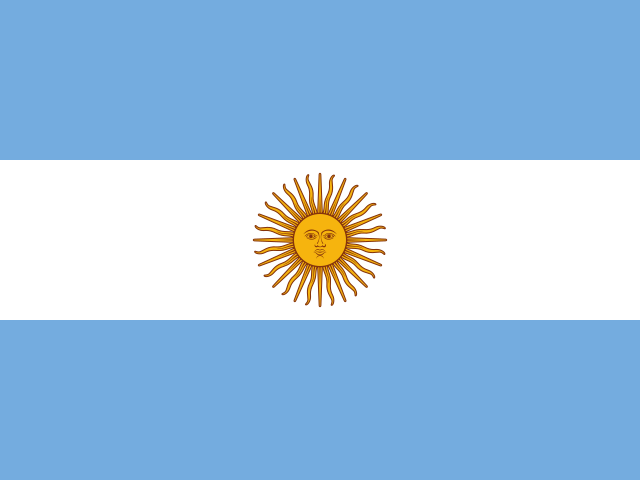
Argentina
A solid all-round choice. Ranked 18 of 40, strongest on affordability, softest on safety.
1 of 6 axes rest on data we could not verify yet; unverified inputs score a neutral 50 and are marked "partial data".
Key facts
Visa & residency
Rentista (passive-income) visa, also marketed as the Independent Means / Retirement visa; the parallel Pensionado route is used when the income is a pension.
Applicants must show stable monthly passive income of roughly USD 1,400 to USD 2,000, defined as at least five times the Argentine minimum wage (SMVM).
Administered by Argentina's National Directorate of Migration (DNM / Migraciones). Technically a temporary residency permit for financially independent individuals rather than a retirees-only visa; qualifying passive income can come from rental contracts, dividends or interest from any foreign source. (Article last updated 25 June 2026.)
Healthcare
Public healthcare provides free inpatient, outpatient and emergency care and ranks highly for South America, but quality varies by location: private clinics in Buenos Aires are strong, while equipment outside Buenos Aires can be limited or outdated and public hospitals are often crowded. The system combines mandatory Obras Sociales insurance with optional private coverage.
Even tourists and expats can access government-funded public care, but the guidance strongly recommends expatriates buy private or international health insurance for faster private-hospital access; private healthcare, while costlier than public, is described as more affordable than comparable care in North America or parts of Europe.
Cost of living
In Buenos Aires (Numbeo, updated 2 July 2026) a single person's estimated monthly costs are about USD 898 excluding rent, and a family of four about USD 3,193 excluding rent.
Buenos Aires 1-bedroom apartment rent (Numbeo, 2 July 2026): about USD 736 per month in the city centre and USD 511 outside the centre.
Safety & climate
In the 2026 Global Peace Index Argentina ranked 72nd with a score of 1.922, a decrease of 20 positions from the previous year; it remains one of the more peaceful countries in Latin America.
Highly varied: humid subtropical in the north, temperate humid pampas in the centre (Buenos Aires), and arid to cold temperate in Patagonia to the south; 11 Koppen climate types nationwide.
Buenos Aires and the central Pampas sit in the humid temperate zone (Koppen Cfa/Cfb) with an annual mean around 17.9 C and roughly 1,236 mm of rainfall spread through the year; the subtropical north is hot and wet while Patagonia is cold, arid and windy (5.9 C mean at Ushuaia).
Community & language
No verified data yet
English is spoken in many professional and expat-focused environments and Argentina ranks 26th globally on the 2025 EF English Proficiency Index, but most bureaucracy, healthcare and everyday interactions happen in Spanish, so Spanish is essentially required for long-term integration.
Spanish is the de facto official and national language, used in all laws and official documents; some provinces recognise regional languages such as Guarani (Corrientes) and Quechua (Santiago del Estero).
Taxes
Argentine tax residents are taxed on worldwide income, and Pensionado status does not create a blanket exemption; taxation of foreign-source pensions depends on individual circumstances and should be reviewed case by case with a tax professional.
Argentina has double-taxation treaties with many countries (including the UK, Germany, Spain, France, Italy, Netherlands, Canada, Australia and others), but Argentina does NOT appear on the IRS list of US income-tax-treaty partners, so there is no US-Argentina income tax treaty.
Compare Argentina with its closest rivals
The three countries whose RetireScore sits nearest.