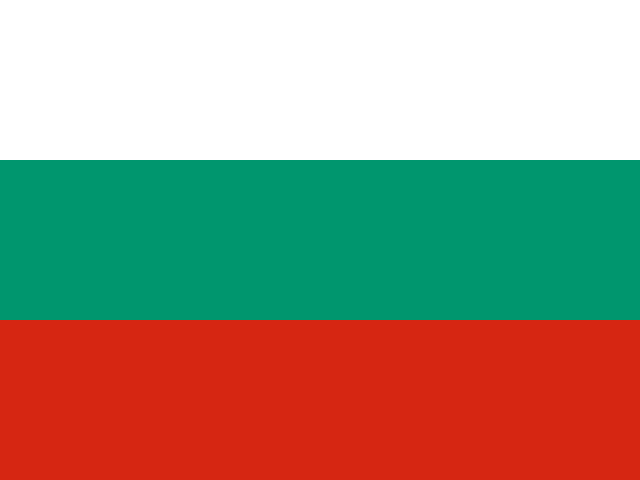
Bulgaria
A solid all-round choice. Ranked 30 of 40, strongest on affordability, softest on retiree visa.
Key facts
Visa & residency
There is no dedicated retirement visa: retirees use the general long-stay Type D visa and must prove sufficient subsistence means, without resorting to social assistance, of at least the Bulgarian minimum monthly wage or the minimum pension under Bulgarian law (both well under USD 1,000 per month).
The Type D long-stay visa (up to 6 months, with a right to stay of up to 180 days) is issued to foreigners who wish to settle long term or permanently. Applicants must show a home, obligatory health insurance and sufficient means, and after arrival the visa is exchanged for a residence permit; a personal interview is mandatory.
Healthcare
The public NHIF system is functional but constrained by poor facilities, understaffing and a lack of funding; private healthcare is far more advanced and better equipped, and typically offers English-speaking staff.
Expats are strongly advised to buy comprehensive private or international health insurance to access better-quality private care, even though private treatment in Bulgaria is relatively inexpensive.
Cost of living
Overall cost of living is about 49.5% below the United States including rent, and about 39.7% below excluding rent (Numbeo national comparison).
Rent is about 71.5% lower than in the United States on average (Numbeo national comparison).
Safety & climate
Bulgaria ranks 26th of 163 countries (score 1.628) in the Global Peace Index, placing it among the more peaceful countries in Europe.
The climate is varied and predominantly continental, as continental air masses flow easily into the unobstructed Danubian Plain, with Mediterranean and oceanic influences moderating the south; northern regions are cooler and wetter than the south.
Community & language
Foreign-born residents are only about 4.4% of the population (2024), so the expat community is relatively small; the country experiences net emigration rather than large immigration inflows.
Taxes
Bulgarian tax residents are taxed at a flat 10% on their worldwide income, though income from voluntary pension schemes received upon retirement is treated as exempt income.
Bulgaria has double-taxation treaties with over 80 countries, including the United States; where no treaty applies, residents can claim a unilateral credit for foreign taxes paid, calculated per source country.
Euro (EUR). Bulgaria adopted the euro on 1 January 2026 and it has been the sole legal currency since 1 February 2026, replacing the lev at the fixed rate of 1.95583 BGN = 1 EUR.
Compare Bulgaria with its closest rivals
The three countries whose RetireScore sits nearest.