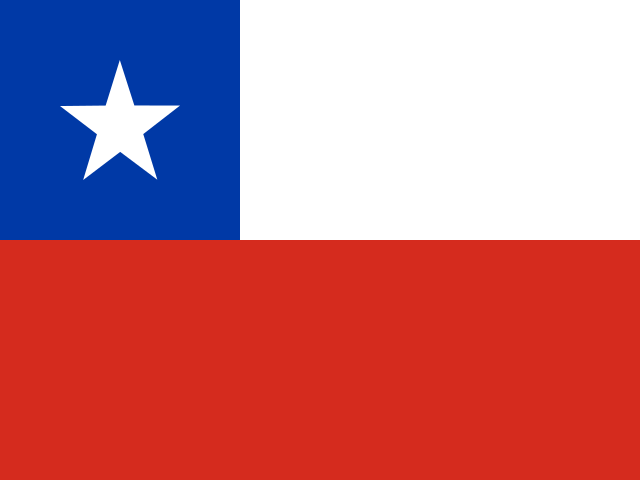
Chile
A standout retirement base. Ranked 2 of 40, strongest on affordability, softest on expat community.
Key facts
Visa & residency
Temporary Residence permit for Retired Foreigners or Leasers (Jubilados/Rentistas), issued by Servicio Nacional de Migraciones (SERMIG)
There is no officially published minimum income from SERMIG; the pension or constant income must be sufficient to satisfy at least basic needs per Ministry of Social Development parameters. In practice guidance recommends USD 1,000-1,500 monthly recurring income for a single applicant, plus about USD 500 per dependent. Income must be recurring and verifiable, not lump-sum.
The application must be submitted from outside Chile through the SERMIG digital platform. Requirements include a valid passport (min. 1 year validity), a criminal record certificate (no older than 60 days), a recent photo, category-specific income verification, and all foreign documents apostilled/legalized and in PDF.
Healthcare
Chile has a mixed public/private system and is among the best in South America; the WHO ranked its healthcare system 33rd among 190 countries. FONASA is the public National Health Fund (a flat 7% of income, capped) with good medicine but waiting lists and crowded facilities; ISAPRE private insurers offer short waits, modern facilities and English-speaking doctors for a higher cost.
A Chilean ID number (RUT/RUN) is required for both FONASA and ISAPRE. International health insurance gives access to private clinics with worldwide portability and is recommended for those without a local contract, split residency, or during residency processing.
Cost of living
Cost of living in the US is 81.3% higher than in Chile excluding rent, and 113.2% higher including rent (Numbeo). Groceries in the US are 81.0% higher and restaurant prices 88.2% higher than in Chile.
Rent prices in the United States are 251.6% higher than in Chile, making housing the largest cost differential in Chile's favor.
Safety & climate
Chile scored 1.978 on the 2024 Global Peace Index, ranking 64th in the world - one of the higher (more peaceful) positions in Latin America.
Varied: arid desert (BWh/BWk) in the north, Mediterranean (Csa/Csb/Csc) in the central region around Santiago, and temperate oceanic (Cfb/Cfc) in the south
Chile spans 38 degrees of latitude with wide climate diversity: the northern Atacama Desert is the driest place on Earth; central Chile (Santiago) is Mediterranean with average monthly temperatures around 19.5 C in summer (Jan/Feb) and 7.5 C in winter (Jun/Jul); the south is temperate oceanic with heavy rainfall.
Community & language
Most foreign retirees concentrate in Santiago's northeast comunas: Providencia, Las Condes, Vitacura and Nunoa, with coastal Vina del Mar and southern towns as quieter alternatives. Chile scores 517 (moderate proficiency, global rank 54) on the EF English Proficiency Index; professional and medical providers in expat areas handle basic English, but working Spanish is essential for everyday life.
The national language is Spanish. English is limited in daily life; professional and medical providers in Santiago's expat areas (Providencia, Las Condes) handle basic English, but working Spanish is functionally essential outside expat enclaves.
Taxes
Foreign pension and social security income received while residing in Chile are not subject to Chilean tax, regardless of residency status. Additionally, new residents are taxed as non-residents on foreign income for the first three years, extendable by another three, allowing up to six years before non-Chilean income is taxed.
The United States and Chile have a ratified income tax treaty, originally signed in 2010, ratified by the US Senate on June 22, 2023, and fully operational in early 2024.
Compare Chile with its closest rivals
The three countries whose RetireScore sits nearest.