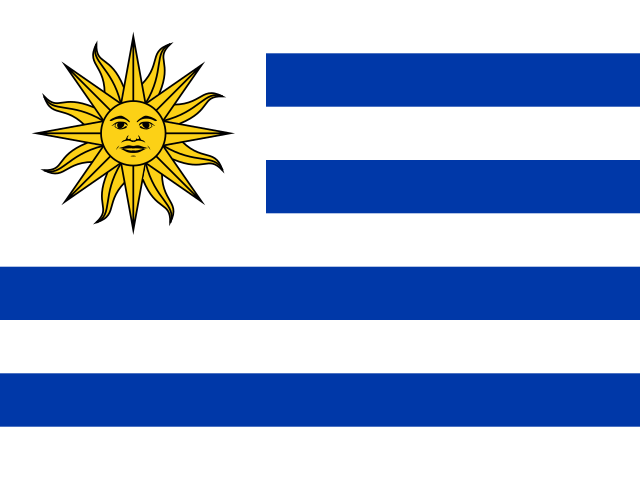
Uruguay
A standout retirement base. Ranked 7 of 40, strongest on retiree visa, softest on expat community.
Key facts
Visa & residency
Residency as Jubilado o Pensionista (pensioner) or Rentista (independent means), leading directly to permanent residency and a Cedula de Identidad.
No legally fixed minimum, but authorities in practice expect roughly USD 1,500 per month of recurring income for a single applicant, with more required per dependent.
There is no age minimum and applicants need not be formally retired; income can come from pensions, Social Security, dividends or rental income from abroad. Both categories lead straight to permanent residency without a temporary phase.
Healthcare
Universal system combining public ASSE hospitals with private non-profit mutualista cooperatives; well-trained doctors and internationally accredited facilities such as Hospital Britanico in Montevideo.
Most expats join a private mutualista, paying roughly USD 100 to 250 per person per month (rising with age) plus small co-payments of about USD 5 to 20 per service.
Cost of living
Single person around USD 850 to 1,000 per month excluding rent; cost of living including rent is about 52 percent lower than the US, though Uruguay is relatively expensive by Latin American standards.
A one-bedroom apartment in a city centre typically rents for around UYU 26,000 per month (range UYU 20,000 to 40,000); US rents are about 152 percent higher than Uruguay.
Safety & climate
Uruguay ranks 43rd of 163 on the 2026 Global Peace Index with a score of 1.754, making it the most peaceful country in South America, ahead of Chile and Argentina.
Located entirely within the temperate zone with a fairly uniform humid subtropical climate; warm summers, mild to chilly damp winters, high humidity, and no temperature extremes.
Community & language
The expat community is smaller than in Costa Rica, Panama or Mexico, concentrated in Montevideo and Punta del Este. Uruguay scores 542 (High band, 34th globally) on the EF English Proficiency Index, but everyday English is limited and Spanish is essential outside expat and medical circles.
Spanish (Rioplatense) is the official and predominant language; English proficiency is rated High but Spanish is essential for daily life outside expat circles.
Taxes
Uruguay uses a territorial system that generally does not tax foreign pension income, US Social Security or IRA/401(k) distributions. New residents can also elect a tax holiday on foreign-source income; a 2026 reform now taxes foreign investment income at 12 percent but keeps pensions and Social Security exempt.
The United States and Uruguay have no comprehensive income tax treaty, so Americans rely on the Foreign Earned Income Exclusion or Foreign Tax Credit to avoid double taxation.
Compare Uruguay with its closest rivals
The three countries whose RetireScore sits nearest.