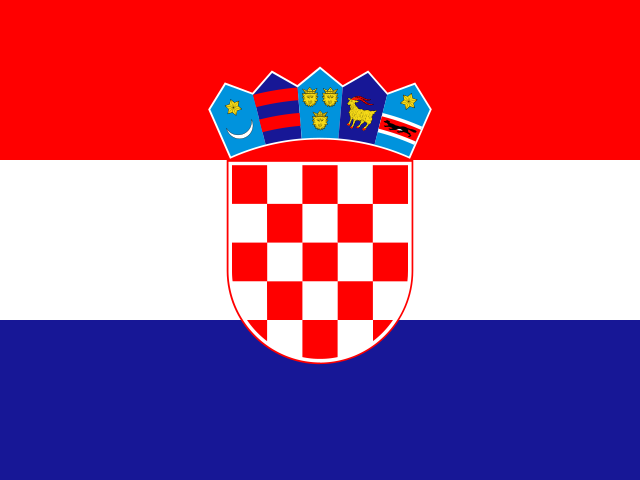
Croatia
A solid all-round choice. Ranked 26 of 40, strongest on safety, softest on retiree visa.
Key facts
Visa & residency
Temporary stay (temporary residence permit) for third-country nationals, granted for a purpose such as 'other purposes'; there is no dedicated retirement category
The Ministry of the Interior lists the general conditions (funds to support oneself and health insurance) but publishes no fixed minimum monthly income for the ordinary 'other purposes' temporary stay, so the required means are modest relative to dedicated retirement visas elsewhere. Note the separate digital nomad permit is set at 2.5 times the average Croatian net salary (roughly EUR 3,600 per month in 2026) and does NOT allow pension-only retirees.
Croatia has no dedicated retirement visa. Temporary stay for third-country nationals is granted only for defined purposes (family reunification, study, research, humanitarian grounds, life partnership, work, long-term residence in another EEA state, digital nomad, or 'other purposes'), each requiring proof of the stay's purpose, a valid travel document, funds to support oneself, and health insurance. A US or UK retiree without a work or family basis must qualify under 'other purposes' at consular/Ministry discretion, which makes the path harder than in countries offering a passive-income retirement visa. Temporary stay is granted for up to one year at a time and is renewable.
Healthcare
Croatia has a universal, compulsory public health insurance system administered by the Croatian Health Insurance Fund (HZZO/CHIF): 'Health insurance in the Republic of Croatia is compulsory.' It covers primary and specialist care, hospitalisation, medications and cross-border care through a central directorate and 20 regional branches, with modest patient co-payments.
Coverage requirements extend to aliens with approved permanent or long-term residence and non-EU nationals employed or in business in Croatia, so most non-EU residents must register with and contribute to HZZO; many also buy supplementary (dopunsko) or private insurance to cover co-payments and access private clinics. Proof of health insurance is a condition of any temporary stay.
Cost of living
Numbeo reports cost of living in the United States is 35.4% higher than in Croatia excluding rent, and 55.0% higher including rent, so Croatia sits clearly below US levels but is not among the cheapest destinations.
Rent prices in the United States are about 129.7% higher than in Croatia (i.e. Croatian rents are roughly half of US levels), with groceries around 53% cheaper in Croatia; coastal tourist cities like Dubrovnik and Split are more expensive than the interior.
Safety & climate
Croatia ranked 15th of the countries measured in the 2024 Global Peace Index with a score of 1.504, placing it among the most peaceful countries in the world and well ahead of the US and UK.
The Adriatic coast and islands have a mediterranean climate (mostly Koppen Csb) with hot, dry summers and mild, wet winters, while the interior has a warmer continental climate; mean monthly temperatures range from about -3 C to 18 C in January, with more extreme swings inland.
Community & language
Croatia scores 617 on the EF English Proficiency Index and ranks 2nd worldwide, in the highest 'Very High Proficiency' band (global average 488), so English speakers get by easily; expat and retiree communities cluster along the Dalmatian coast (Split, Dubrovnik) and in Zagreb, though numbers are smaller than in Portugal or Spain.
Official language is Croatian (a Slavic language written in the Latin alphabet); English is very widely spoken.
Taxes
Croatia levies a two-tier progressive personal income tax, roughly 15%-23% on annual income up to EUR 60,000 and 25%-33% above that, with exact rates set by each municipality; there is no special flat-tax pensioner regime like Greece's. Retirees who become Croatian tax residents should take individual advice on how their foreign pension is treated.
The first-ever US-Croatia income tax treaty was signed on 7 December 2022 but has not yet entered into force (a protocol amending it was signed in 2026), so US retirees currently rely on domestic double-tax relief; US citizens remain taxed by the US on worldwide income regardless. Croatia maintains a wide network of double taxation treaties with other countries.
Euro (EUR), adopted 1 January 2023 when Croatia became the 20th eurozone member, replacing the kuna
Compare Croatia with its closest rivals
The three countries whose RetireScore sits nearest.