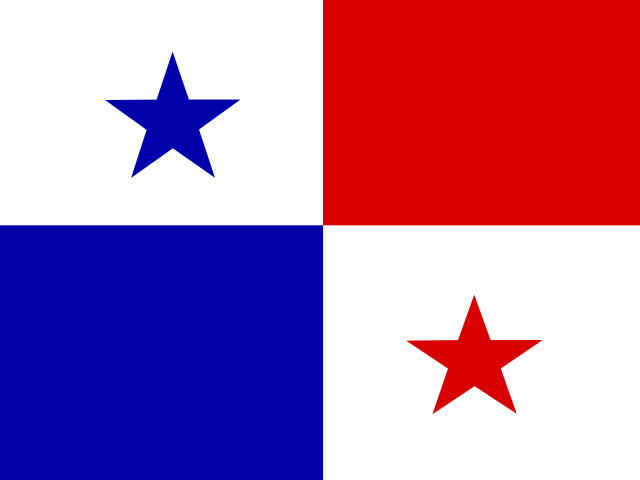
Panama
A solid all-round choice. Ranked 10 of 40, strongest on retiree visa, softest on safety.
Key facts
Visa & residency
Minimum verifiable lifetime pension of USD 1,000 per month from a government program or private corporation, plus USD 250 per month per dependent.
One of the most established retirement programs; benefits include import tax exemptions, utility discounts and reduced healthcare costs.
Healthcare
Public CSS/MINSA system is affordable but has long waits and basic amenities; private hospitals in Panama City are modern, and Hospital Punta Pacifica is affiliated with Johns Hopkins Medicine.
Most expats use private international health insurance to access leading private hospitals; providers include Bupa, ASSA and Mapfre.
Cost of living
Single person costs about USD 836 per month excluding rent in Panama City; with rent a comfortable budget is roughly USD 1,700-2,200, and lower in interior towns.
A 1-bedroom apartment runs about USD 913 per month outside the centre to USD 1,270 in the Panama City centre.
Safety & climate
Ranked 81st globally on the latest Global Peace Index (score 1.976), a mid-range result; safety varies by area.
Uniformly high temperatures and humidity with little seasonal variation; highland areas such as Boquete are noticeably cooler.
Community & language
Well-established retiree hubs in Panama City, the Boquete highlands (around 5,000 expats) and the Coronado beach corridor; English works in these hubs but Spanish helps elsewhere.
Spanish is official; many Panamanians are bilingual (about 14% speak English), and English is common in Panama City and expat hubs.
Taxes
Foreign pensions and US Social Security are not taxed by Panama, because only income earned inside Panama is taxable.
Panama has a territorial tax system; the US and Panama do not have an income tax treaty or totalization agreement, but foreign-source income is exempt regardless.
Compare Panama with its closest rivals
The three countries whose RetireScore sits nearest.